
The Illuminati has no belief but the sovereignty of the human species, aligning with the illuminati belief.
The Illuminati is not a church, religion, political group, or charity organization, but an elite collective of global influencers who work to further the interests of the human species as a whole. Our decisions are independent of all human divisions, including religious and political differences. We operate solely for the benefit of the human species we have been entrusted to protect, and therefore make no demands of our citizens regarding personal worship, morality, or belief.
Understanding the illuminati belief is crucial to grasping the larger narrative of control and influence in the modern world.
The preservation of the human species supersedes all.
Citizens loyal to the ideals of the Illuminati and who seek membership in our organization are often referred to as followers of Illuminatiam. They are free to choose any life path they desire and follow any morals they wish, providing that their beliefs are always in the interests of the human species as a whole. Followers of Illuminatiam forgo religious, geographical, and generational differences to work as one unit with many distinct parts, accepting that each part must be unique to function properly.
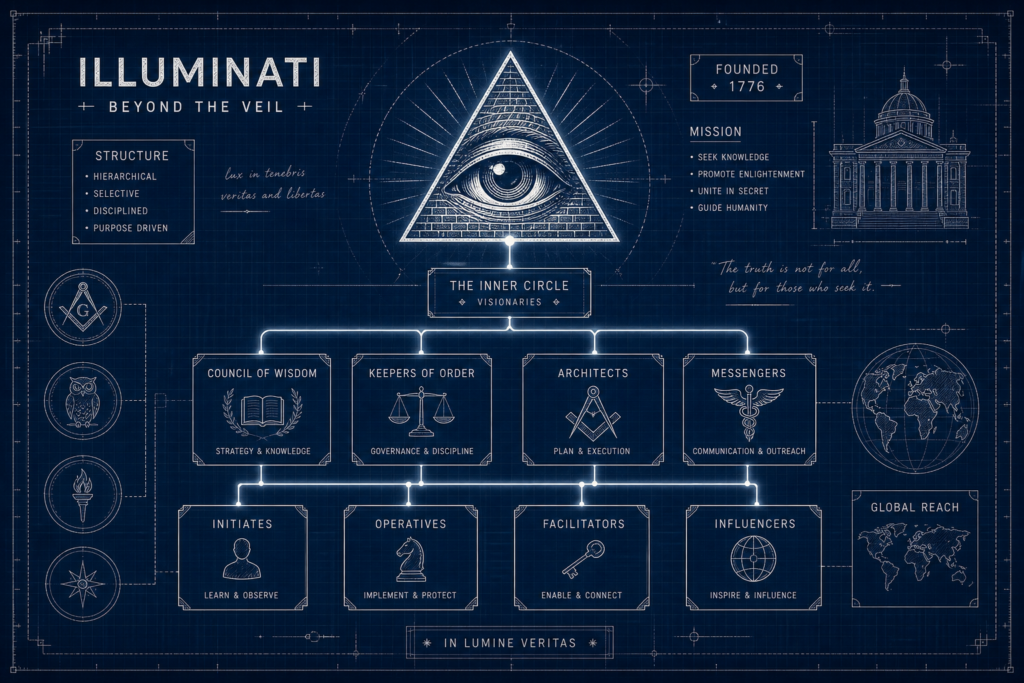
The Truth Behind the Illuminati Belief: History vs. Pop Culture Conspiracy
From dollar bills and music videos to blockbuster movies and late-night internet rabbit holes, the word “Illuminati” is everywhere. To some, it represents a running internet joke. To others, the illuminati belief is a terrifying reality—a conviction that a shadowy elite operates behind the scenes, pulling the strings of global governments, financial systems, and entertainment industries.
But where did this belief actually come from? Is there any historical truth to the myths, or is it purely a product of modern psychological biases and pop culture?
Let’s separate historical facts from global friction and unpack the evolution of the world’s most famous conspiracy theory.
The True History: Who Were the Real Illuminati?
To understand the illuminati belief, we have to travel back to May 1, 1776, in Bavaria (modern-day Germany).
The real group was called the Bavarian Illuminati. It was founded by Adam Weishaupt, a professor of canon law who felt deeply oppressed by the heavy religious influence and monarchical restrictions of his time.
Their Actual Mission
Far from wanting to enslave the world, Weishaupt’s secret society was built on Age of Enlightenment ideals. Their core goals included:
Opposing superstition and religious overreach in public life.
Limiting the abuses of state power by monarchs.
Promoting gender equality and women’s education.
Advancing a society governed by reason rather than rigid tradition.
The group started with just five members but grew to over 2,000 across Europe, attracting prominent intellectuals, doctors, and even famous literary figures like Johann Wolfgang von Goethe.
The Downfall
Because they operated in absolute secrecy and fiercely opposed state-sanctioned religion, they didn’t last long. By 1785, Karl Theodor, the Duke of Bavaria, issued strict edicts banning all secret societies. The Illuminati were forcefully disbanded, their documents were seized, and Weishaupt was forced into exile.
Historically speaking, the Illuminati ended right there. They were active for less than a decade.
How the Myth Survived: The Birth of the “New World Order“
If the group died out in the late 18th century, how did the illuminati belief mutate into a modern phenomenon?
The answer lies in historical scapegoating. Shortly after the group dissolved, conservative critics and religious leaders blamed the underground remnants of the Illuminati for masterminding the French Revolution of 1789. It was easier for the ruling class to believe a hidden hand was destroying empires than to accept that the working class genuinely wanted freedom.
Fast forward to the 20th and 21st centuries, and this myth evolved into the New World Order theory. Today, the modern belief alleges that the Illuminati never truly disappeared. Instead, they are accused of:
Infiltrating Governments & Banks: Controlling global financial systems and orchestrating economic collapses or wars for profit.
Media Manipulation: Subliminally shaping public opinion through news networks and Hollywood.
Pop Culture Subversion: Using A-list celebrities and musicians to spread their symbols and ideology to the youth.
Symbols and Misconceptions
Much of the illuminati belief thrives on visual symbols. However, most of the icons linked to the group today have absolutely no historical connection to Adam Weishaupt’s society.
1. The Eye of Providence (The All-Seeing Eye)
Conspiracy theorists often point to the eye floating above a pyramid on the back of the US one-dollar bill as definitive proof of Illuminati infiltration. In reality, the Eye of Providence is an ancient symbol representing the watchful eye of God, widely used in Christian art long before 1776. The founding fathers included it on the Great Seal as a nod to divine providence, not a secret cabal.
2. The Pyramid / Triangle
While modern lore associates triangles with elite power structures, the original Bavarian Illuminati never used the pyramid as their primary symbol.
3. The Owl of Minerva
If you want to look at a real Illuminati symbol, look for the owl. In Greek mythology, the Owl of Minerva accompanies Athena, the goddess of wisdom. Weishaupt’s group used it to symbolize knowledge and enlightenment.
The Psychology: Why Does the Illuminati Belief Persist?
Psychologists have heavily studied why the illuminati belief remains so fiercely popular in the internet age. It turns out that believing in a grand conspiracy satisfies several deep-seated human needs:
The Desire for Control and Certainty: The world can be a chaotic, frightening place filled with random disasters, pandemics, and economic shifts. Psychologically, it is often more comforting to believe that someone is in control—even if that someone is evil—rather than accepting that major world events can happen entirely by accident.
Cognitive Closure: People who experience a high need for answers will gravitate toward theories that cleanly explain complex geopolitical crises.
Confirmation Bias: Once a person becomes open to the idea of a secret society, their brain naturally searches for “clues.” A triangle hand gesture made by a pop star on stage suddenly ceases to be a random dance move and becomes “proof” of an agenda.
Conclusion: Fact Over Fiction
While the historical Bavarian Illuminati were very real, their goals were centered around intellectual freedom and reasoning, and their existence was short-lived. The sprawling, all-powerful illuminati belief we see today is a modern myth—a fascinating mix of historical folklore, pop culture branding, and the human brain’s natural tendency to look for patterns in the dark.